
| Target | |
|---|---|
| Synonyms | CD161, KLRB1, NKR, NKR-P1, NKR-P1A, NKRP1A, CLEC5B, Natural Killer Cell Surface Protein P1A, Killer Cell Lectin-Like Receptor Subfamily B Member 1, C-Type Lectin Domain Family 5 Member B |
| Description | Recombinant Cynomolgus CD161 protein with N-terminal human Fc tag |
| Delivery | In STOCK |
| Uniprot ID | A0A7N9D796 |
| Expression Host | HEK293 |
| Tag | N-Human Fc tag |
| Molecular Characterization | hFc(Glu99-Ala330)+CD161(Gln67-Leu227) |
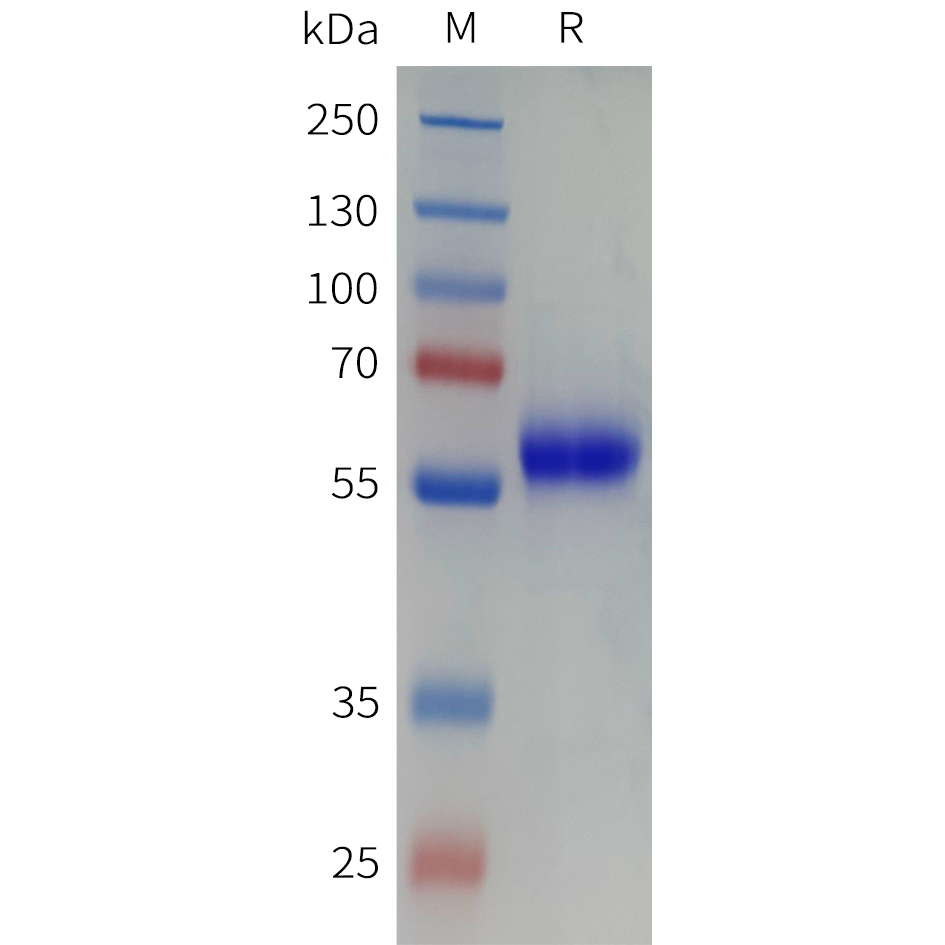
| Molecular Weight | The protein has a predicted molecular mass of 44.7 kDa after removal of the signal peptide. |
| Purity | The purity of the protein is greater than 95% as determined by SDS-PAGE and Coomassie blue staining. |
| Formulation & Reconstitution | Lyophilized from sterile PBS, pH 7.4. Normally 5 % – 8% trehalose is added as protectants before lyophilization. Please see Certificate of Analysis for specific instructions of reconstitution. |
| Sterility | Products are supplied non-sterile. For cell culture applications, dilute in appropriate medium and sterile-filter (0.22 µm) prior to use. |
| Storage&Shipping | Store at -20°C to -80°C for 12 months in lyophilized form. After reconstitution, if not intended for use within a month, aliquot and store at -80°C (Avoid repeated freezing and thawing). Lyophilized proteins are shipped at ambient temperature. |
| Background | CD161, also known as KLRB1 or NKR-P1A, is a type II transmembrane glycoprotein belonging to the C-type lectin-like receptor family. It contains an extracellular C-type lectin-like domain, a single transmembrane region, and an intracellular cytoplasmic domain. CD161 is expressed on natural killer (NK) cells and several T-cell subsets, including natural killer T (NKT) cells, mucosal-associated invariant T (MAIT) cells, and subsets of CD4+ and CD8+ T cells. The major ligand of CD161 is lectin-like transcript 1 (LLT1), also known as CLEC2D. Interaction between CD161 and LLT1 regulates immune-cell activation, cytokine production, and cytotoxic activity. Depending on the immune-cell type and cellular context, CD161 signaling may exert inhibitory or costimulatory effects. The CD161/LLT1 signaling axis is involved in immune surveillance, inflammation, infectious diseases, and tumor immunity, making CD161 a potential target for immunological and cancer-related research. |
| Usage | Research use only |
| Conjugate | Unconjugated |
Cynomolgus CD161 Protein, hFc Tag
Price:10μg $100.00 ; 50μg $358.00 ; 100μg $528.00
Product Data Dima FAQ
Images Dima FAQ
Figure 1. Cynomolgus CD161 Protein, hFc Tag on SDS-PAGE under reducing condition.
Related Products
Biosimilar reference antibodies
SKU: BME100648 Target: CD161
Application: ELISA, Flow Cyt
Price: 50 μg $82.00 ; 100 μg $162.00

Biosimilar reference antibodies
SKU: BME100648B Target: CD161
Application: N/A
Price: 100μg $199.00
ECD Proteins
SKU: PME101350 Target: CD161 Tag: N-Human Fc Tag
Expression Host: HEK293
Price: 10μg $79.00; 50μg $281.00 ; 100μg $422.00