
Blocking Antibody Screening Service
What Are Blocking Antibodies?
Blocking antibodies are antibodies that inhibit a specific ligand–receptor interaction or signaling pathway. By preventing these interactions, blocking antibodies help determine:
- The mechanism of action (MoA) of a therapeutic target
- Whether an antibody candidate can interrupt functional binding events
- The biological relevance of antibody target engagement
- The likelihood that a candidate may become a therapeutically effective antagonist
Blocking assays such as ELISA based blocking, cell-based flow cytometry blocking, and SPR/BLI competition assays are therefore essential tools throughout antibody drug development, from early discovery and lead selection to functional validation.
Challenges in Blocking Antibody Screening
Despite being essential, blocking antibody screening is often difficult to establish internally:
- Long development cycles: Building a stable, sensitive blocking assay can take weeks of optimization.
- Poor reproducibility: Variability in ligand quality, antibody titration, or cell conditions often leads to inconsistent results.
- Technical complexity: Each assay format requires specialized expertise and dedicated instruments.
- High resource demand: Reagents, labor, and repeated optimization increase overall cost.
- Lack of validated controls: Without reliable positive antibodies, confirming assay performance becomes challenging.
Why Choose DIMA BIOTECH's Service
To address these challenges, DIMA BIOTECH has established a comprehensive blocking antibody screening platform with multiple validated target-specific blocking assays, enabling rapid and reliable evaluation of functional antibodies.
- Multiple Validated Blocking Assays Already Established
- Multiple Analytical Formats Supported: ELISA or FC cell-based blocking assays
- High Sensitivity & Reproducibility: Each assay is validated with well-characterized positive controls to ensure consistent performance.
- High Throughput & Versatile Sample Types: Supports nanobodies, rabbit mAbs, human/mouse antibodies, bispecifics, and antibody libraries.
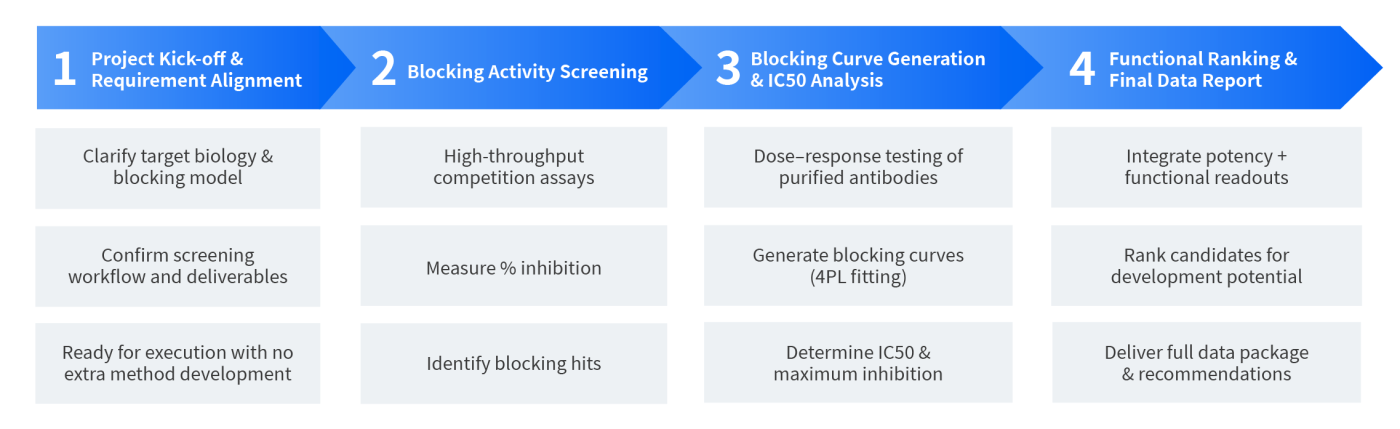
Service Workflow
Case Studies
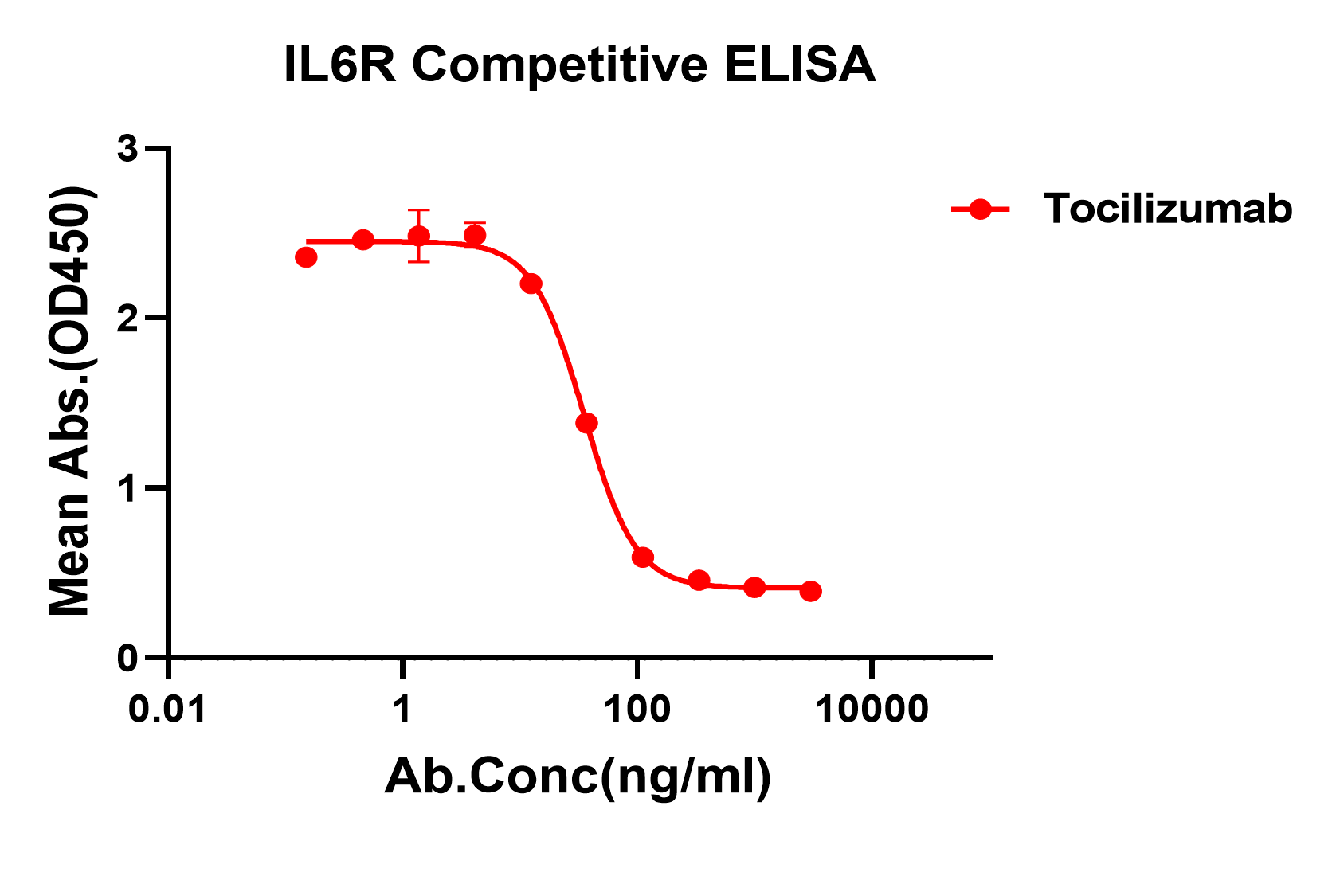
IL6R blocking ELISA assay
Competitive ELISA showing inhibition of IL-6R–ligand binding by a tocilizumab biosimilar. Serial antibody dilutions were incubated with IL-6R-hFc, followed by IL-6-mFc-His detection. The blocking curve yields an IC₅₀ of 35.11 ng/mL.

IL7RA Blocking ELISA assay
Competitive ELISA showing inhibition of IL-7RA–ligand binding by a Bempikibart biosimilar. Serial antibody dilutions were incubated with IL-7RA-hFc, followed by biotinylated lL7-hFc detection. The blocking curve yields an IC₅₀ of 25.96 ng/mL.
Successfully Developed Blocking Assays
| Target | Ligand/Receptor | Reference Antibody |
| 41BBL | 41BB | SC113.153 |
| ACVR2A | Activin A | bimagrumab |
| ACVR2B | Activin A | bimagrumab |
| CD47 | SIRPα | magrolimab |
| CSF1R | M-CSF | cabiralizumab |
| EGFR | EGF | Cetuximab |
| HER3 | NRG1 | seribantumab |
| patritumab | ||
| IL21 | IL21R | avizakimab |
| IL21R | IL21 | ATR 107 |
| IL31RA | IL-31 | nemolizumab |
| Target | Ligand/Receptor | Reference Antibody |
| IL4RA | IL4 | dupilumab |
| IL6R | IL6 | tocilizumab |
| IL7RA | IL7 | bempikibart |
| IL7 | bempikibart | |
| MET | HGF | emibetuzumab |
| OX40 | OX40L | KH 72577-3 |
| PD1 | PDL1 | pembrolizumab |
| PDL1 | PD1 | atezolizumab |
| TIGIT | CD155 | etigilimab |
| Canine PD1 | Canine PDL1 | INTERVET 4F12 |
| Canine IL31 | Canine IL31RA | lokivetmab |
| Feline IL31 | Feline IL31RA | dovanvetmab |
FAQ
1. What types of antibody samples can you screen?
We can accept a wide range of antibody sources, including:
- Purified antibodies (IgG, Fab, VHH)
- Hybridoma supernatants
- B-cell culture supernatants
- Ascites fluid
- Phage-displayed antibodies (with expression support if needed)
Samples will be matched to the appropriate screening method based on volume and purity.
2. How much sample is needed?
Typical sample requirements:
- Purified antibodies: >50 ug (for primary screening; more needed for lC50 analysis)
- Supernatants: >200ul at a concentration of 2 μg/mL
- Ascites fluid: ≥200–500 μL
If sample amount is limited, small-scale expression or purification can be arranged.
3. What blocking screening methods do you use?
Common approaches include:
- ELISA-based competitive blocking assays
- Flow cytometry-based blocking (FACS) assays
Assay choice is tailored to the target to ensure reproducible and comparable results.
4. How is blocking activity determined?
Blocking activity is evaluated using:
- Percent inhibition (% blocking)
- Dose–response curves and IC50
- Comparison with known positive control antibodies
Optional functional readouts (e.g., pathway inhibition, cellular phenotypes)
5. What is the difference between primary screening and IC50 analysis?
- Primary screening: Rapid identification of antibodies with potential blocking activity.
- IC50 analysis: Quantitative evaluation of hit antibodies to determine true blocking potency.
Both steps together provide a comprehensive assessment of blocking activity.
6. How long does the screening take?
Typical timelines:
- Primary screening: ~5–10 business days
- IC50 analysis: ~7–14 business days
- Functional cell-based assays (optional): 1–2 additional weeks
Expedited services can be arranged for urgent projects.
7. What is included in the data report?
Standard report package includes:
- Blocking percentage (% inhibition) from primary screening
- Blocking curves and IC50 values from secondary screening
- Epitope competition/BLI data (if applicable)
- Functional assay data (if performed)
- QC information and experimental conditions
- Technical conclusions and recommendations for further development
8. Can you perform epitope competition analysis?
Yes, using BLI or SPR to evaluate:
- Ligand competition
- Receptor competition
- Antibody–antibody epitope overlap
Mutant proteins can also be included for more detailed epitope mapping.
9. Do we need to provide target protein or cell models?
Not necessarily. We can supply:
- Recombinant proteins in various tag formats (many common targets in stock)
- Established stable or transient cell lines
Clients may also provide their own antigens for customized assays.
10. Is confidentiality guaranteed?
Yes. All samples, experimental procedures, and data are strictly confidential under a signed NDA.