Tag Free Recombinant Protein Service

Tag-free proteins are essential for various research applications. They closely mimic their native forms, allowing for more accurate studies of biological functions and interactions. This is particularly important in fields like drug development, vaccine research, and structural biology.

Purifying tag-free proteins presents unique challenges:

  • Lack of Specific Antibodies: Unlike tagged proteins, tag-free proteins do not have established affinity purification methods.
  • Stability and Solubility Issues: Without tags, some proteins can be less stable and soluble, which complicates the purification process.

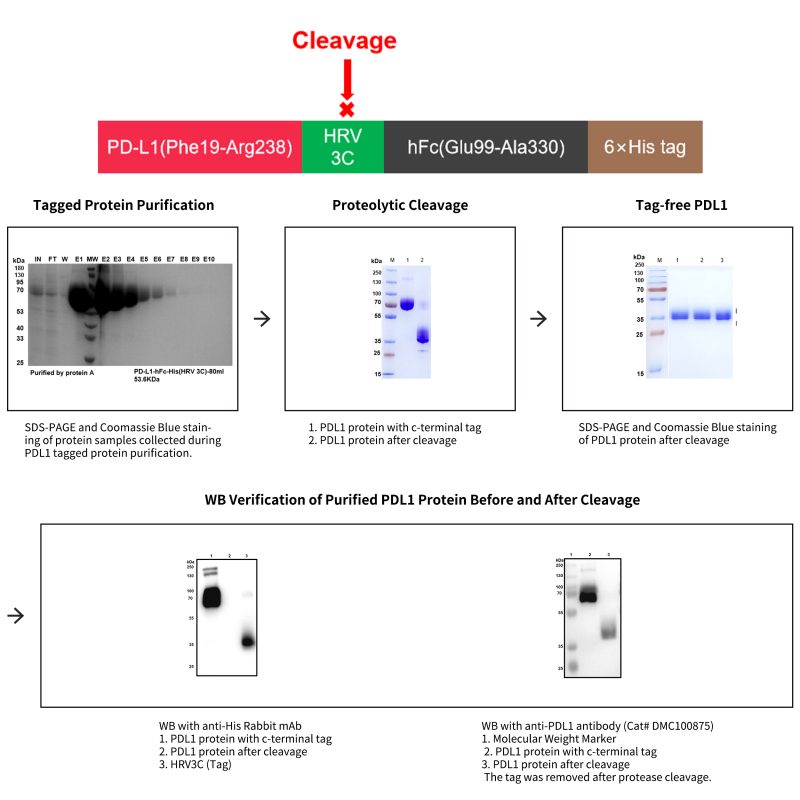
At DIMA, we employ a cleavable tag system that combines the benefits of tagged proteins with the final advantages of tag-free proteins. Our approach includes fusion tags for better expression and purification efficiency, and protease system for precise cleavage, ensuring minimal impact on protein functionality.

Advantages of Untagged Proteins

  • Native Structure: Retaining their natural conformation, untagged proteins are better for studying protein interactions and enzyme activities.
  • Better Functionality: Untagged proteins preserve their natural biological activity, leading to more reliable results.
  • Versatile Applications: Ideal for drug development, vaccine research, structural biology, and high-throughput screening.

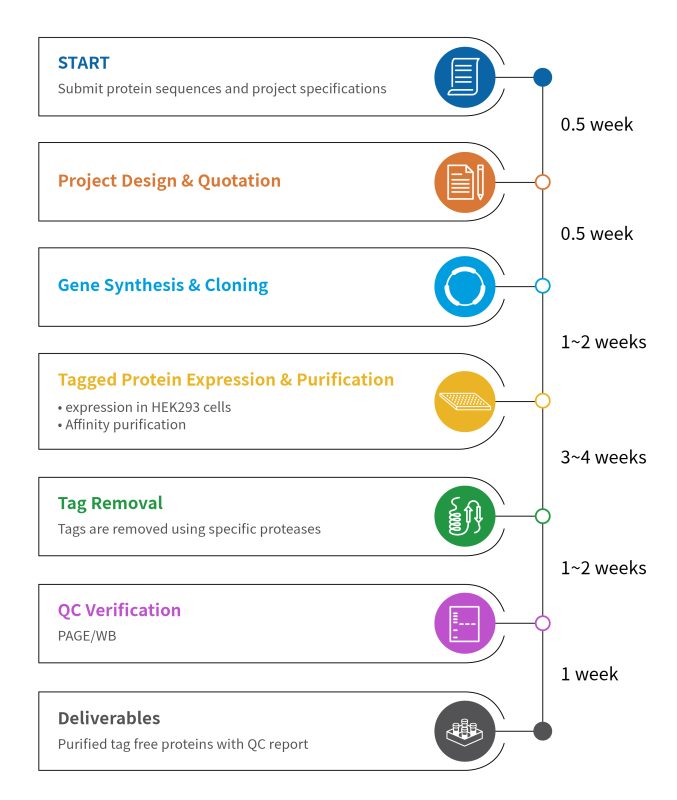
Workflow

Proteases for Tag Cleavage

ProteaseCleavage SiteNote
HRV 3C ProteaseLEVLFQ/GPWidely used for its specificity and efficiency.
EnterokinaseX-Asp-Asp-Asp-Asp-Lys-â-Not Proline-XIdeal for removing tags like the FLAG tag.
SUMO ProteaseRecognize the tertiary structure of SUMO Highly specific for the SUMO protein fusion,
TEV ProteaseENLYFQG/SKnown for high specificity.
ThrombinLVPR/GS Commonly used in many expression systems.
Factor XaIEGR or IDGRcleavage site can easily be inserted between a tag sequence and the protein of interest.
Request A Quote

Highlights

  • Mammalian Cell Expression: Ensures proper folding and post-translational modifications for functional proteins.
  • Multiple Removable Affinity-tag Strategies are Available: selected according to the protein type, expression system, required purity, and downstream application.
  • Cleavable Tag Technology: Easily removes tags after purification, providing pure, untagged proteins.
  • Simplified Process: Cleavable tag and affinity purification streamline the process, saving time and resources—ideal for high-throughput and large-scale production.
  • High Success Rate: Delivers consistent, high-quality results.
  • Membrane Protein Expertise: Specializes in challenging membrane proteins and drug targets.

FAQs

1. What is a tag-free recombinant protein?

A tag-free recombinant protein is a protein delivered without fusion tags such as His, Fc, GST, or SUMO, making it more similar to the protein in its native state.

2. Why choose tag-free proteins?

Removing fusion tags can minimize their potential impact on protein conformation, biological activity, and molecular interactions. Tag-free proteins are therefore well suited for applications such as drug screening, structural studies, and protein–protein interaction analysis.

3. How are tag-free proteins produced?

Typically, the target protein is first expressed with a cleavable affinity tag and purified by affinity chromatography. The tag is then removed by specific protease cleavage, followed by secondary purification to obtain the final tag-free protein.

4. Why not express the protein without a tag from the beginning?

Proteins expressed without an affinity tag lack a universal handle for affinity purification, which can make purification more challenging. A cleavable-tag strategy combines efficient expression and purification with the ability to deliver a high-quality tag-free final protein.

5. Which proteases can be used for tag removal?

Available options include HRV 3C Protease, TEV Protease, SUMO Protease, Enterokinase, Thrombin, and Factor Xa. The optimal protease and cleavage strategy are selected based on the protein sequence and downstream application.

6. Which expression system is used?

DIMA BIOTECH uses mammalian cell expression systems, which support proper folding, post-translational modifications, and preservation of the biological activity of complex proteins.

7. How is protein purity ensured after tag removal?

Following protease cleavage, secondary purification is performed to remove free tags, residual protease, uncleaved fusion proteins, and other impurities. The final protein is further evaluated by quality control methods such as PAGE and Western blot.

8. What does the custom tag-free protein service include?

The service covers project design, gene synthesis and vector construction, protein expression, affinity purification, tag removal, secondary purification, quality control, and final product delivery.

9. What information is required for project evaluation?

We recommend providing the protein name, species, amino acid sequence or desired expression region, target yield, purity requirement, buffer requirement, and intended downstream application.

Testmonial

Dr. Chen, Senior Scientist

We have been using DIMA’s protein preparation service for several projects, and the results have been outstanding. The proteins were not only high quality but also maintained their biological activity, which is essential for our assays. The fast turnaround time and the expertise of their staff made collaboration easy and efficient. I highly recommend their services to any researcher looking for reliable and efficient protein preparation.

Tag-free Protein Request Form