
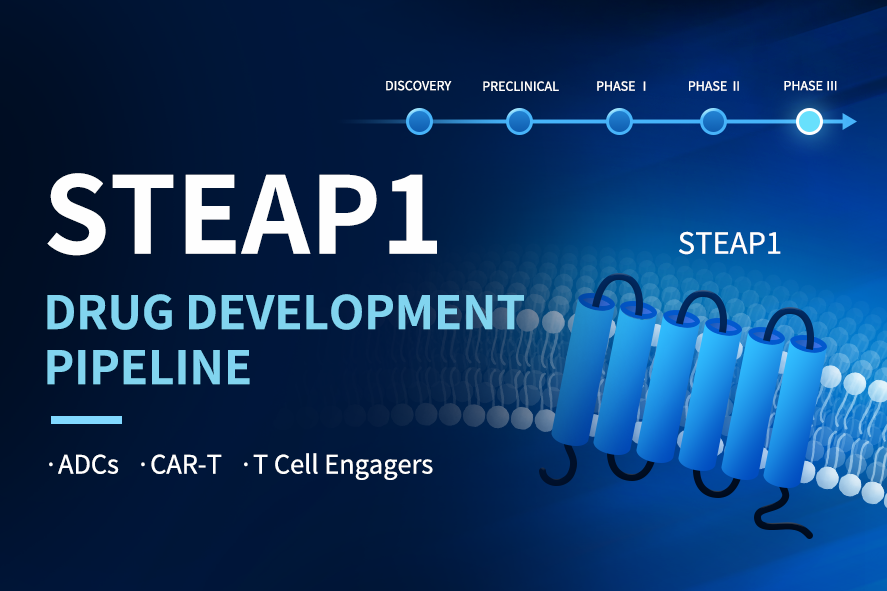
In our previous article, “STEAP1: An Emerging Therapeutic Target for Prostate Cancer,” we introduced the structure and biological functions of STEAP1, as well as its potential value as a therapeutic target. In recent years, STEAP1-targeted drug development has achieved significant progress. The first STEAP1-targeted therapy, xaluritamig, has entered Phase III clinical development, while multiple other therapeutic modalities—including bispecific ADCs, CAR-T therapies, and trispecific T-cell engagers—are also advancing rapidly.
Building on the previous article, this article focuses on the latest developments in STEAP1-targeted drug pipelines and discusses future trends in the field.
1. From Early Target Validation to Phase III Clinical Development
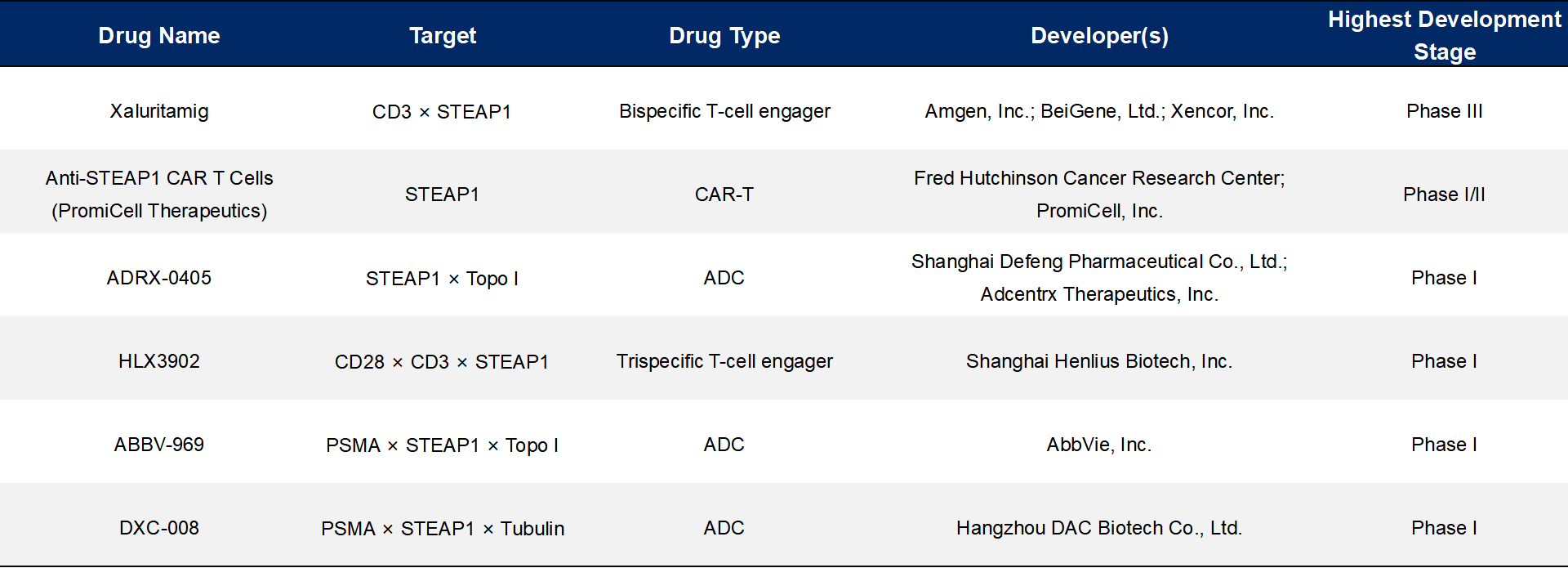
Based on the currently identified STEAP1 drug pipeline, six programs have entered clinical development, including:
- One program in Phase III clinical development
- One program in Phase I/II clinical development
- Four programs in Phase I clinical development
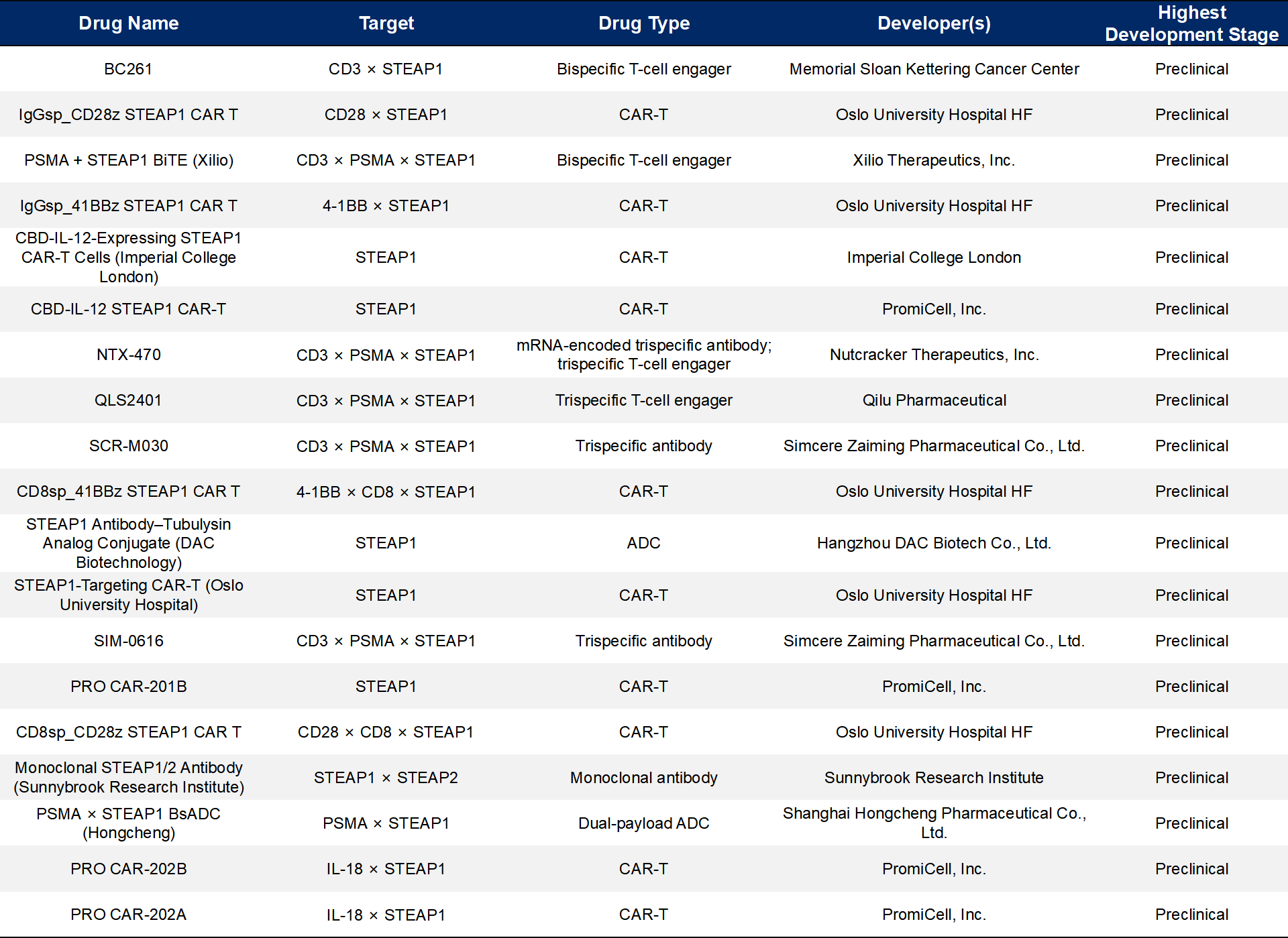
- Nineteen programs in preclinical development
- Four programs in the drug discovery stageIn terms of therapeutic modality
STEAP1 drug development now encompasses a wide range of approaches, including T-cell engagers, antibody-drug conjugates (ADCs), CAR-T therapies, multispecific antibodies, therapeutic vaccines, small-molecule drugs, and radiopharmaceutical diagnostic agents.
Among these, T-cell engagers, ADCs, and CAR-T therapies currently represent the three major categories of STEAP1-targeted drugs in clinical development.
2. Clinical-Stage Programs: STEAP1 Enters Pivotal Clinical Validation
Table 1. Clinical-Stage STEAP1-Targeted Drug Programs
2.1 Xaluritamig: The First STEAP1-Targeted Therapy to Enter Phase III
Xaluritamig, originally developed under the code name AMG 509, is currently the most advanced STEAP1-targeted drug in clinical development. It adopts an XmAb 2+1 format comprising two STEAP1-binding arms and one CD3-binding arm. By simultaneously binding STEAP1 on tumor cells and CD3 on T cells, xaluritamig promotes the formation of an immune synapse and induces T-cell-mediated killing of STEAP1-positive tumor cells.
In its first-in-human dose-exploration study, xaluritamig was administered to 97 patients with heavily pretreated metastatic castration-resistant prostate cancer (mCRPC). In the overall population, the PSA50 response rate was 49%, while the objective response rate among patients with measurable disease was 24%. Among patients receiving higher target doses, the PSA50 response rate and objective response rate reached 59% and 41%, respectively.
These results provided the first clinical validation of the antitumor activity of a STEAP1-targeted T-cell engager in a relatively large patient population and supported the advancement of xaluritamig into Phase III development.
2.2 STEAP1 CAR-T: Advancing into Phase I/II Clinical Evaluation
Anti-STEAP1 CAR T-cell therapy is being advanced by the Fred Hutchinson Cancer Research Center, PromiCell, and other organizations. A Phase I/II study is currently evaluating STEAP1 CAR-T cells in combination with enzalutamide in patients with mCRPC.
The study is primarily designed to assess:
- The safety and dose-limiting toxicities of STEAP1 CAR-T therapy
- The in vivo expansion and persistence of CAR-T cells
- The feasibility of combination treatment with enzalutamide
- Preliminary efficacy endpoints, including changes in PSA levelsradiographic responses, and disease control
The study is currently recruiting patients, and no clinical efficacy data in humans have yet been publicly disclosed.
2.3 ABBV-969: A Dual-Target ADC Demonstrating Early Clinical Activity
ABBV-969 is a dual-variable-domain antibody-drug conjugate that simultaneously targets PSMA and STEAP1 and carries a topoisomerase I inhibitor payload.Prostate cancer is characterized by substantial intratumoral and interlesional heterogeneity. Some tumor cells may predominantly express PSMA, whereas others may primarily express STEAP1. By recognizing both PSMA and STEAP1, ABBV-969 is designed to broaden tumor-cell coverage and reduce the impact of insufficient expression or antigen loss involving either single target.
In a Phase I first-in-human study presented at the 2026 ASCO Annual Meeting, 49 heavily pretreated patients with mCRPC received ABBV-969. Patients had received a median of five prior lines of therapy, and enrollment did not require a predefined PSMA or STEAP1 expression threshold.At pharmacologically active dose levels:The PSA50 response rate was approximately 67%,the PSA90 response rate was approximately 28%.
Among 29 RECIST-evaluable patients, the confirmed objective response rate was approximately 45%These findings suggest that the PSMA/STEAP1 dual-target ADC has promising preliminary antitumor activity in heavily pretreated patients with mCRPC who were not selected based on biomarker expression.
2.4 ADRX-0405: A Next-Generation Single-Target STEAP1 ADC
ADRX-0405 is a STEAP1-targeted ADC composed of a humanized anti-STEAP1 antibody, a cleavable linker, and a topoisomerase I inhibitor payload.Its Phase Ia/Ib study is evaluating the safety, tolerability, pharmacokinetics, recommended dose, and preliminary efficacy of ADRX-0405 in patients with prostate cancer, gastric cancer, non-small cell lung cancer, and other advanced solid tumors expressing STEAP1.
The first patient was dosed with ADRX-0405 in 2025, and the program received clinical trial authorization from China’s National Medical Products Administration in June 2026. To date, no human efficacy results for ADRX-0405 have been publicly disclosed.
2.5 DXC-008: A STEAP1/PSMA Dual-Target ADC Enters Phase I
DXC-008, developed by Hangzhou DAC Biotech, is an ADC with dual-binding activity against STEAP1 and PSMA. It uses a tubulysin analog as its cytotoxic payload.Preclinical studies have shown that DXC-008 has high affinity for STEAP1 while retaining a certain degree of binding activity toward PSMA. It has demonstrated antitumor activity in prostate cancer models with varying levels of STEAP1 and PSMA expression.
DXC-008 is currently being evaluated in a Phase I first-in-human study enrolling patients with prostate cancer, Ewing sarcoma, and other relevant solid tumors. The study is primarily assessing safety, maximum tolerated dose, dose-limiting toxicities, the recommended Phase II dose, pharmacokinetics, and preliminary antitumor activity.To date, no human efficacy data for DXC-008 have been publicly disclosed.
2.6 HLX3902: A Trispecific T-Cell Engager Incorporating CD28 Costimulation
HLX3902 is a trispecific T-cell engager that simultaneously targets STEAP1, CD3, and CD28.Conventional STEAP1×CD3 T-cell engagers primarily recruit and activate T cells through CD3 signaling. HLX3902 adds a CD28 costimulatory signal to provide both the primary T-cell activation signal and a costimulatory signal. This design is intended to enhance T-cell proliferation, sustained cytotoxic activity, and memory T-cell formation.
The approach is particularly relevant to the immunologically “cold” tumor microenvironment of prostate cancer. T-cell infiltration in prostate tumors is generally limited, and multiple immunosuppressive factors are present. Activation through CD3 alone may therefore be insufficient to sustain T-cell function and may lead to more rapid T-cell exhaustion.
In May 2026, HLX3902 received authorization to initiate clinical trials in Australia. In June of the same year, it also received clinical trial approval in China. The developers plan to conduct Phase I studies in China, Australia, and other regions.To date, no human efficacy or safety data for HLX3902 have been reported.
3. Preclinical Programs: Multitarget Strategies and Enhanced Cell Therapies Emerge as Major Directions
Table 2. Preclinical STEAP1-Targeted Drug Programs
3.1 T-Cell Engagers Are Evolving from Bispecific to Multispecific Formats
Early STEAP1-targeted T-cell engagers primarily adopted a STEAP1×CD3 format, as exemplified by BC261. Their basic mechanism is similar to that of xaluritamig: STEAP1 is used to identify and bind tumor cells, while CD3 is engaged to recruit and activate T cells. An increasing number of next-generation programs are adopting trispecific designs targeting PSMA, STEAP1, and CD3, including NTX-470, QLS2401, SCR-M030, and SIM-0616. In these constructs:PSMA and STEAP1 broaden the coverage of prostate cancer cells
CD3 recruits and activates T cellsThis strategy is intended to address heterogeneous antigen expression and reduce the risk of tumor escape caused by low or lost expression of a single target.
3.2 STEAP1 CAR-T Represents the Most Intensively Pursued Preclinical Modality
Among current preclinical STEAP1 programs, CAR-T therapies account for the largest number of candidates. Their development can be broadly divided into three major directions.
① Comparison of Different Costimulatory Domains
Oslo University Hospital has developed multiple STEAP1 CAR-T constructs incorporating either CD28 or 4-1BB costimulatory domains, including:
IgGsp_CD28z STEAP1 CAR T
IgGsp_41BBz STEAP1 CAR T
CD8sp_CD28z STEAP1 CAR T
CD8sp_41BBz STEAP1 CAR
TCD28 generally induces more rapid and robust T-cell activation, whereas 4-1BB is more commonly associated with improved metabolic fitness and prolonged cellular persistence. Comparing these constructs may help identify CAR designs that are better suited to the treatment of solid tumors.
② Cytokine-Enhanced CAR-T Therapies
Programs such as CBD-IL-12 STEAP1 CAR-T, PRO CAR-202A, and PRO CAR-202B are exploring designs involving IL-12– or IL-18-related signaling.
These “armored” CAR-T therapies are intended to:Remodel the immunosuppressive tumor microenvironment
- Enhance CAR-T-cell activation within tumor tissues
- Recruit endogenous immune cells
- Delay CAR-T-cell exhaustion
- Improve the killing of tumor cells with low antigen density
However, both IL-12 and IL-18 are potent immune-activating cytokines. A major challenge for future development will be restricting their activity to the tumor microenvironment while minimizing systemic inflammatory toxicity.
③ Expansion from Prostate Cancer to Ewing Sarcoma
STEAP1 is highly expressed not only in prostate cancer but also in Ewing sarcoma. Programs such as PRO CAR-201B and PRO CAR-202B have included Ewing sarcoma as a major indication under development.
Should STEAP1 expression prove sufficiently stable across different patients and tumor lesions, Ewing sarcoma could become an important indication for STEAP1-targeted CAR-T therapies.
3.3 Preclinical ADC Programs Explore New Payloads, Dual-Targeting, and Dual-Payload Designs
Preclinical ADC programs include the STEAP1 Antibody Tubulysin Analog Conjugate and PSMA×STEAP1 bispecific ADCs.Compared with earlier programs such as vandortuzumab vedotin, which used an MMAE payload, newer candidates are exploring:
- Tubulysin and related analogs
- Topoisomerase I inhibitors
- Dual-target recognition of PSMA and STEAP1
- Dual-payload or differentiated payload combinations
These strategies are intended to improve tumor-cell coverage, enhance cytotoxic potency, and address heterogeneity in both antigen expression and drug sensitivity.
3.4 Combined Recognition of STEAP1 and STEAP2 Remains Exploratory
A STEAP1/2 monoclonal antibody developed by Sunnybrook Research Institute is designed to recognize both members of the STEAP protein family.
Combined targeting may broaden tumor coverage. However, STEAP2 has a different normal-tissue expression profile from STEAP1. Therefore, binding to normal tissues and the potential risk of on-target, off-tumor toxicity will require particularly careful evaluation.
4. Early-Stage and Discontinued Programs: Lessons for STEAP1 Drug Development
Although the current STEAP1 development landscape is increasingly focused on clinical-stage programs, several candidates remain in the drug discovery stage. Other early programs have been discontinued because of insufficient efficacy, safety concerns, or changes in development strategy. Although these programs did not advance into late-stage clinical development, they have provided important insights for the design of next-generation STEAP1-targeted therapies.
Table 3. Drug Discovery-Stage and Other STEAP1-Targeted Programs
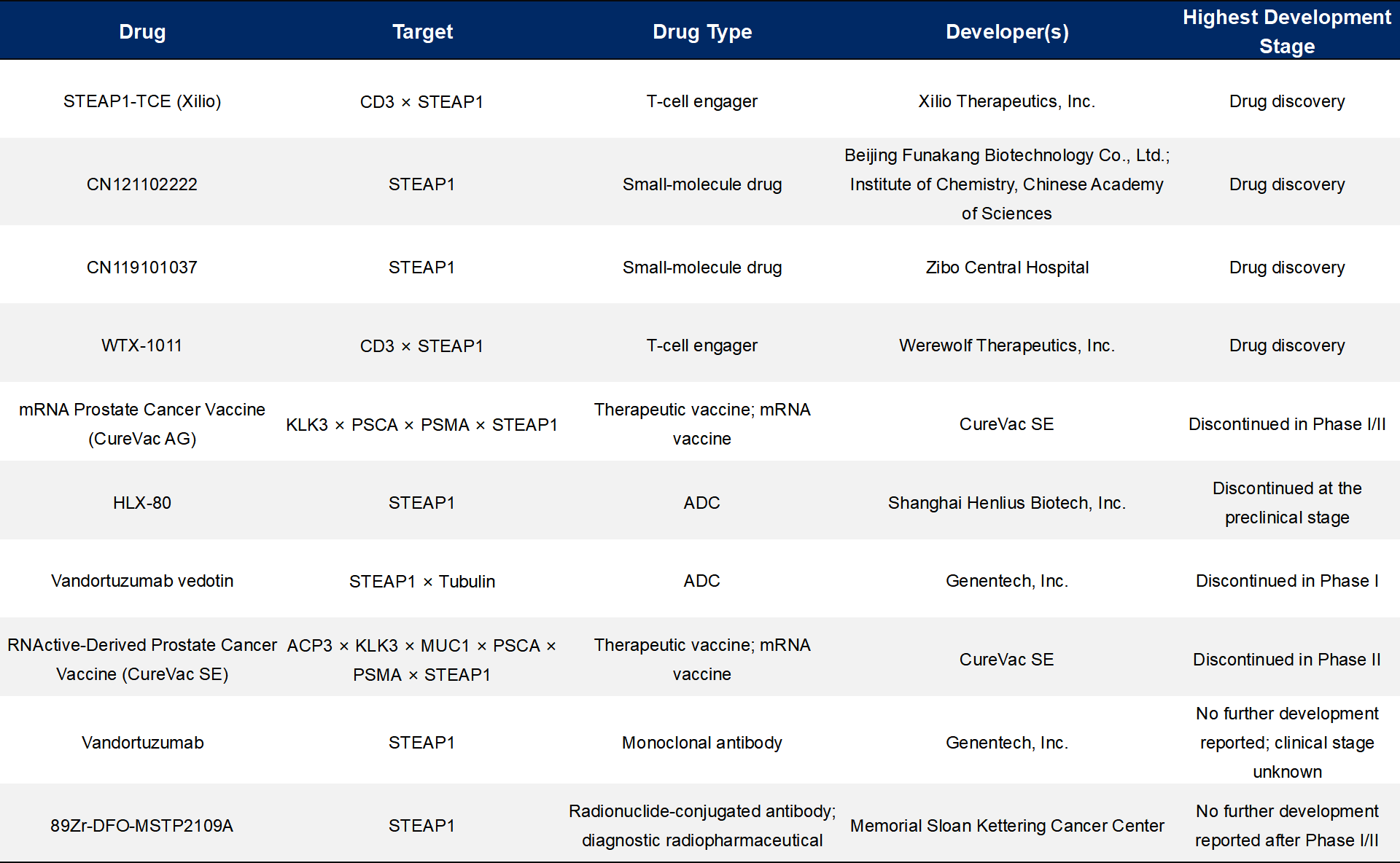
At present, STEAP1 programs in the drug discovery stage mainly include early small-molecule, T-cell engager, and CAR-T projects. Publicly available information remains limited, and most of these programs are still at the proof-of-concept stage.
By contrast, discontinued programs have provided important lessons for subsequent drug development. For example, the early ADC vandortuzumab vedotin demonstrated the feasibility of STEAP1 as an ADC target. However, its development was ultimately discontinued because of limited clinical efficacy and toxicity associated with the MMAE payload. CureVac’s multivalent mRNA vaccine for prostate cancer also failed to deliver the expected clinical benefit.
The development of next-generation STEAP1-targeted therapies is now increasingly shifting toward dual-target designs, more optimized ADC payloads, and enhanced T-cell therapies. In addition, STEAP1-targeted molecular imaging probes may have potential applications in patient selection and treatment-response assessment and could become important complementary tools for future precision therapies.
5. Research Tools for STEAP1-Targeted Drug Development
STEAP1 is a six-pass transmembrane cell-surface protein. Compared with soluble targets, the development of STEAP1-targeted antibodies and cell therapies depends more heavily on proteins that retain a near-native conformation and on stable expression of the target on the cell surface.
DIMA Biotechnology currently provides a range of research tools for STEAP1-targeted drug development, including full-length membrane proteins, extracellular domain proteins, reference antibodies, and lead antibody molecules, including:
| Product Type | SKU | Product Name |
| ECD Proteins | PME101530 | Human STEAP1 Protein, hFc Tag |
| PME101961 | Human STEAP1(1-70) Protein, hFc Tag | |
| PME101962 | Human STEAP1(312-339) Protein, hFc Tag | |
| Full Length Transmembrane Proteins | FLP100070 | Human STEAP1 full length protein-synthetic nanodisc |
| FLP120070 | Human STEAP1-Strep full length protein-synthetic nanodisc | |
| CFP100009 | Human STEAP1 cell-free full length protein-Detergent | |
| CFP200009 | Human STEAP1 cell-free full length protein-Nanodisc | |
| Biosimilar reference antibodies | BME100188 | Anti-STEAP1(Vandortuzumab biosimilar) mAb |
| BME100208 | Anti-STEAP1(xaluritamig without CD3 biosimilar) mAb | |
| BME100188B | Biotinylated Anti-STEAP1(Vandortuzumab biosimilar) mAb | |
| BME100208B | Biotinylated Anti-STEAP1(xaluritamig without CD3 biosimilar) mAb | |
| BME100188P | PE-conjugated Anti-STEAP1(Vandortuzumab biosimilar) mAb | |
| BME100208P | PE-conjugated Anti-STEAP1(xaluritamig without CD3 biosimilar) mAb |
- Research Progress on STEAP1-Targeted Lead Molecules

