
Cadherin (CDH) Family Targets
1. Introduction to Cadherins (CDH Family)
Cadherins are a class of calcium-dependent transmembrane cell adhesion proteins that play essential roles in maintaining tissue integrity, cell polarity, and development. A typical Cadherin protein consists of extracellular cadherin (EC) repeats, a single transmembrane segment, and a cytoplasmic domain that mediates interactions with cytoskeletal and signaling proteins. In cancer, dysregulated expression or function of CDH family members is closely linked to epithelial mesenchymal transition (EMT), tumor invasion, metastasis, and drug resistance. Increasingly, CDH targets are being explored in antibody, ADC, and other targeted therapy development for solid tumors.
2. Cadherins/CDH Family Classification and Structural Features
In mammals, Cadherin family proteins can be broadly classified based on their extracellular repeat architecture and cytoplasmic interaction motifs, including Classical Cadherins, Atypical Cadherins and Protocadherins.
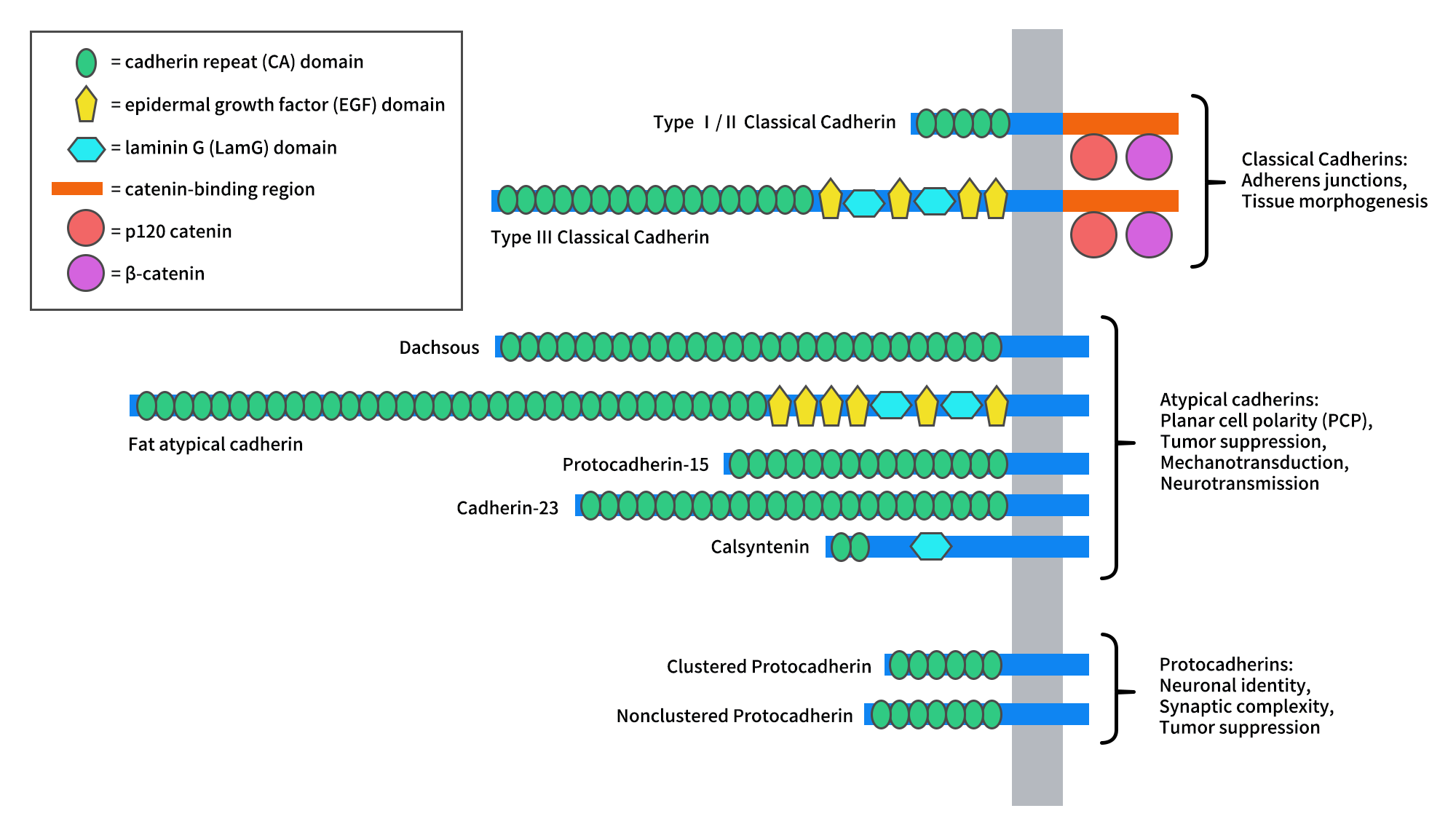
Figure 1. Main structures and functions of three cadherin subfamilies [1]
2.1 Classical Cadherins
These members contain five extracellular cadherin repeats (EC1–EC5) that require Ca²⁺ for structural stability, a single transmembrane domain, and a conserved intracellular tail with p120- and β-catenin binding sites. This enables strong cell–cell adhesion and linkage to the cytoskeleton. Functions include maintaining epithelial integrity and regulating EMT and tumor progression. Representative human targets include CDH1, CDH2, CDH3, CDH5, and CDH6.
2.2 Atypical Cadherins
These exhibit numerous cadherin repeats and additional structural motifs (e.g., EGF-like or LamG), with variable intracellular regions that often lack classic catenin binding. They participate in cell polarity, morphogenesis, and signal regulation. Key human members include CDH17, CDH23, FAT1–FAT4, and DCHS1/2.
2.3 Protocadherins
Featuring 6–7 cadherin repeats and lacking canonical cytoplasmic catenin interaction motifs, Protocadherins mainly contribute to neuronal development and synaptic specificity. Common human members include PCDH7, PCDH9, PCDH10, and the PCDHα/β/γ clusters.
3. Prominent Cadherin (CDH) Targets and Research Focus
CDH3/P-cadherin
- Major Expression: Tumors
- Diseases: Breast, Ovarian cancer
- R&D Interest: Very High
- Drug Modality:ADC, BsAb
- Key Challenges: Epitope selection
CDH6/Cadherin 6
- Major Expression: Kidney, Ovary
- Diseases: RCC, Ovarian cancer
- R&D Interest: High
- Drug Modality:ADC
- Key Challenges: Homology
CDH17/Cadherin 17
- Major Expression: GI tract
- Diseases: GI cancers
- R&D Interest: High
- Drug Modality:ADC, CAR-T
- Key Challenges: Complex ECD
4. DIMA BIOTECH’s Comprehensive Cadherin (CDH) Target Solutions
Cadherin family targets present common challenges in antibody and ADC research. Their extracellular domains are often highly dependent on native conformation and Ca²⁺ stabilization, making antibodies generated from improperly folded antigens ineffective for cell-based recognition. In addition, the high sequence and structural similarity among CDH members increases the risk of cross-reactivity, while atypical Cadherins with large or complex extracellular regions pose further difficulties in expression and epitope validation.
Effective Cadherins research therefore relies on complementary experimental strategies, including multi-domain extracellular proteins that preserve native-like structures, live cell based antibody screening, and reference antibodies for benchmarking specificity and functionality. DIMA BIOTECH supports Cadherins focused research with a comprehensive portfolio of multi-species, multi-domain recombinant proteins, live cell flow cytometry-validated antibodies, and reference antibodies, enabling efficient antibody screening, epitope mapping, and functional evaluation in early-stage therapeutic studies.