
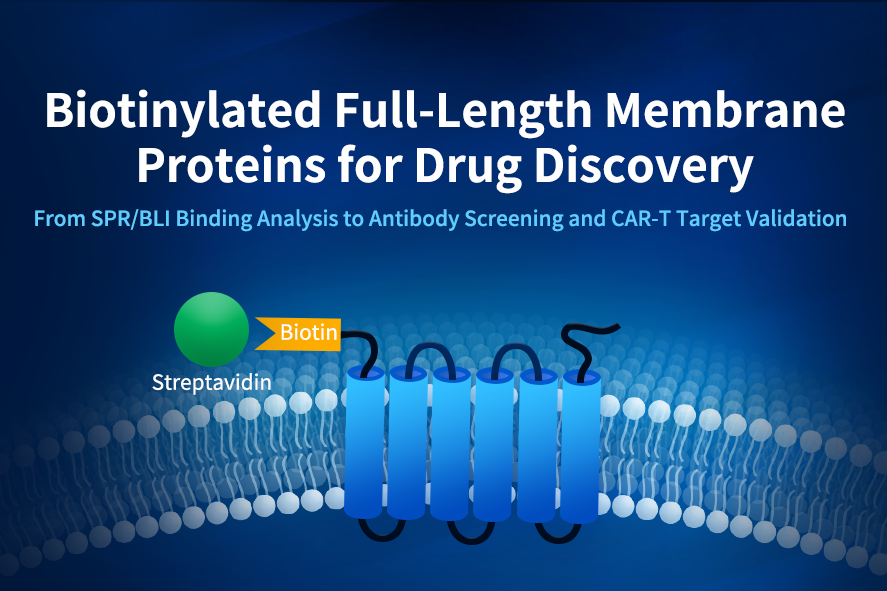
Accurately characterizing the interaction between drug candidates and membrane protein targets is a critical step in antibody therapeutics, cell therapy, and targeted drug development. Reliable target presentation directly affects hit identification, candidate ranking, and lead optimization.
Compared with conventional soluble protein formats, full-length membrane proteins preserve more target-relevant structural information, including transmembrane regions and extracellular domains. However, their practical use remains challenging because immobilization, capture, and detection methods may alter protein orientation, accessibility, or functional activity.
Biotinylated full-length membrane proteins combine the structural advantages of full-length targets with the efficient capture and detection capabilities of the Biotin-Streptavidin system. This creates a flexible and standardized reagent format for membrane protein binding analysis, antibody discovery, cell therapy target validation, and multiplex immunoassays.
Key Takeaways
- Standardized capture can improve consistency across SPR, BLI, magnetic bead, microplate, and fluorescence-based workflows.
- Full-length target presentation supports the discovery and validation of antibodies against native or conformation-dependent epitopes.
Biotinylated targets can support antibody screening, kinetic analysis, CAR-T and bispecific antibody validation, and assay development.
1. Why Biotinylated Full-Length Membrane Proteins Are Well Suited for Drug Discovery
1.1 Minimize the Impact of Immobilization on Protein Function
In SPR, BLI, and other binding assays, immobilization chemistry can directly influence data quality. Random amine coupling relies on accessible surface groups and may lead to inconsistent orientation, masking of key binding regions, or reduced protein activity. These effects are particularly important for structurally complex and conformation-dependent membrane targets.
- More consistent target presentation than random chemical coupling
- Lower risk of masking key extracellular binding regions
- Gentle and stable capture that helps preserve target activity
1.2 Provide a Standardized Capture Interface Across Platforms
A Biotin tag provides full-length membrane proteins with a unified experimental interface. Through Streptavidin-mediated capture, the same target format can be integrated into multiple assay platforms, simplifying workflow transfer and improving consistency across drug discovery stages.
- SPR and BLI biosensors
- Magnetic bead-based screening platforms
- Microplate-based assays
- Fluorescence and multiplex detection systems
This standardized capture strategy turns the full-length membrane protein from a single-purpose research material into a versatile reagent that can support target validation, screening, characterization, and assay development.
2. Key Applications of Biotinylated Full-Length Membrane Proteins
Drug discovery teams require different membrane protein tools at different stages, from candidate binding assessment and antibody screening to cell therapy target validation. Biotinylated full-length membrane proteins combine stable capture, broad platform compatibility, and relevance to complex membrane targets, making them suitable for several critical workflows.
2.1 SPR and BLI Binding Analysis
Surface Plasmon Resonance (SPR) and Bio-Layer Interferometry (BLI) are widely used real-time interaction technologies for evaluating antibodies, protein therapeutics, ligands, and other candidates against their targets. For full-length membrane proteins, reliable immobilization is essential for maintaining target relevance and generating reproducible kinetic data.
Common immobilization approaches include amine coupling, His-tag capture, and Biotin-Streptavidin capture. The high-affinity Biotin-Streptavidin interaction provides stable target capture and offers several advantages:
- Reduced impact of random immobilization on target structure
- Improved accessibility of extracellular and ligand-binding regions
- More consistent target presentation across sensors and assay runs
- Support for affinity and kinetic measurements, including KD, kon, and koff
These features support antibody candidate screening, lead ranking, affinity optimization, and ligand-receptor interaction studies. For GPCRs, immune checkpoints, and other complex membrane targets, biotinylated full-length proteins can provide an assay system that more closely reflects the native target state.
2.2 Antibody Discovery and Screening
The antigen format used during antibody discovery can strongly influence the properties of the resulting antibodies. Soluble extracellular domains may not fully reproduce the native cell-surface architecture of membrane targets. Biotinylated full-length membrane proteins can serve as standardized antigens for hybridoma screening, phage display, single B-cell antibody discovery, and antibody binding validation.
- Support discovery of antibodies against native and conformation-dependent epitopes
- Provide more complete target information than soluble fragments alone
- Enable reproducible magnetic bead capture for high-throughput screening
- Facilitate programs targeting GPCRs, tumor-associated membrane antigens, and immune checkpoints
2.3 CAR-T, TCR-T, and Bispecific Antibody Development
As CAR-T, TCR-T, and bispecific antibody technologies advance, researchers need standardized tools to assess the interaction between engineered receptors or multispecific molecules and membrane antigens. Biotinylated full-length membrane proteins can support CAR-to-antigen binding assessment, engineered receptor expression analysis, and characterization of bispecific antibody binding to membrane targets.
Compared with assays that depend exclusively on target-expressing cells, standardized biotinylated antigens can reduce variability caused by differences in cellular expression levels. They also provide a flexible alternative for targets with low expression or for projects in which stable cell models are difficult to establish.
2.4 Immunoassay and Multiplex Platform Development
Biotinylated full-length membrane proteins can also be incorporated into ELISA, MSD, Luminex, and magnetic bead-based assays. A unified Biotin-Streptavidin capture format can simplify assay setup, improve inter-assay consistency, and support larger-scale screening. For teams developing standardized detection platforms, this format can reduce method-development complexity and improve research efficiency.
3. DIMA BIOTECH Biotinylated Full-Length Membrane Proteins
DIMA Bio develops full-length membrane proteins using Nanodisc technology and mammalian cell expression systems. Expression in a more native-like cellular environment supports proper folding, conformational stability, post-translational modifications, and functionally relevant target structures.
Combined with Biotin labeling, DIMA Bio full-length membrane proteins offer native-like target presentation, high-quality protein preparation, and compatibility with multiple drug discovery platforms. They can support SPR/BLI binding analysis, antibody discovery and screening, CAR-T positivity assessment, and research on complex membrane protein targets.
Key Product Advantages
Mammalian cell expression: Supports the proper folding and post-translational modification of complex membrane proteins, helping reproduce target structures that are closer to the native state.
Full-length target format: Preserves transmembrane regions and extracellular domains, making the proteins suitable for conformation-dependent antibody screening, kinetic analysis, and cell therapy target validation.
Biotin labeling: Provides a stable and efficient capture interface through the high-affinity Biotin-Streptavidin interaction, improving workflow reproducibility and detection reliability.
Broad application compatibility: Supports SPR/BLI affinity analysis, antibody discovery, CAR-T positivity assessment, and other membrane-target research workflows.
