
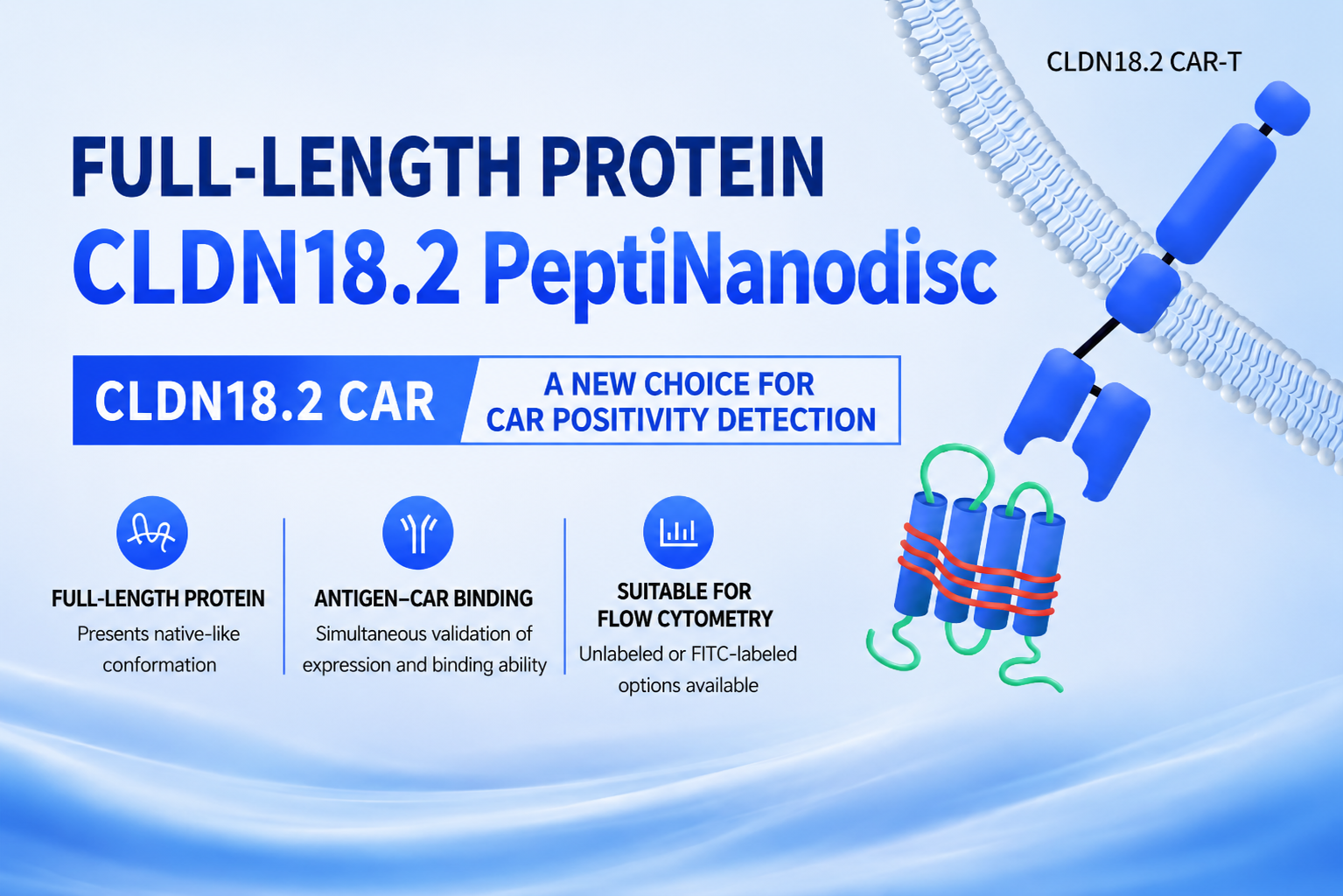
On June 22, 2026, satri-cel, an autologous CAR-T cell therapy targeting CLDN18.2 developed by CARsgen Therapeutics, was approved for marketing. This marks the world’s first approved CAR-T product for the treatment of solid tumors. This milestone indicates that CAR-T therapy is expanding from hematologic malignancies into solid tumors, while also bringing renewed attention to the CLDN18.2 target.
During the development of CLDN18.2 CAR-T therapies, one fundamental and critical question must be answered:
“How many cells successfully express the CAR after transduction or editing? And can these CARs correctly recognize the CLDN18.2 antigen?”
This is exactly what CAR positivity detection is designed to evaluate.
1. Detecting CAR expression does not necessarily prove target recognition
Protein L, anti-Fab antibodies, or anti-linker antibodies are commonly used for CAR positivity detection. These methods can determine whether CAR-related structures are expressed on the cell surface. However, they detect the light chain, Fab, or linker regions of the CAR, rather than directly proving that the CAR still retains the ability to recognize its target antigen.
This is especially important for complex membrane protein targets such as CLDN18.2. CLDN18.2 is a typical four-pass transmembrane protein with short extracellular regions. Some CARs may recognize epitopes formed by extracellular loops and their spatial conformation. Using truncated extracellular fragments alone may fail to fully present the native antigen structure, leading to weakened binding signals or even false-negative results.
Therefore, using full-length CLDN18.2 in a structure closer to its native state as the detection antigen can provide more biologically meaningful results for CAR positivity analysis.
2. PeptiNanodisc: Direct detection of CAR-positive cells using full-length CLDN18.2 protein
DIMA Biotechnology’s PeptiNanodisc technology uses specifically designed amphipathic peptides to wrap the hydrophobic regions of membrane proteins, enabling full-length membrane proteins to remain stable in aqueous solution.
This system does not require a lipid bilayer or membrane scaffold proteins. It can preserve the transmembrane regions, extracellular regions, and relative spatial relationships of CLDN18.2, thereby presenting an antigen conformation closer to the native state.
In CAR positivity detection, PeptiNanodisc identifies CAR-positive cells through the specific binding between full-length CLDN18.2 and the CAR.
Therefore, it can not only answer:
“How many cells express the CAR?”
but also further verify:
“Do these CARs still have the ability to recognize CLDN18.2?”
For more information on the technical principles of PeptiNanodisc, comparisons of CAR positivity detection methods, and complete experimental data, please refer to our previous article: Solving the Challenge of Detecting CAR Positivity for Membrane Proteins: PeptiNanodisc to the Rescue!
2.1 Experimental validation: CLDN18.2 PeptiNanodisc can be used for CAR positivity detection
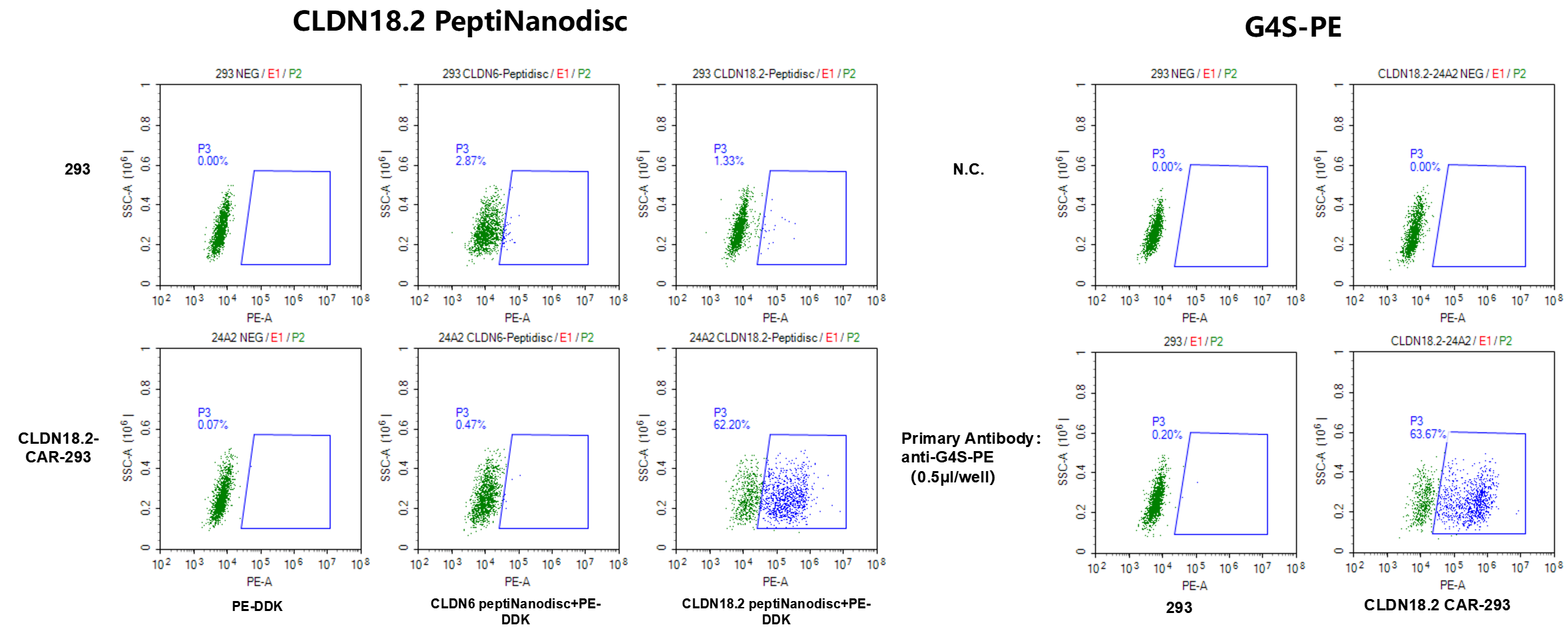
DIMA Biotechnology used Human CLDN18.2 Full Length Protein-PeptiNanodisc, Cat. No. FLP420014, to perform flow cytometry analysis of CLDN18.2 CAR-transduced cells. The results showed that this product can specifically recognize CAR-expressing cells and can be used for CAR positivity analysis.
Experimental results demonstrated that both the unlabeled and FITC-labeled versions of CLDN18.2 PeptiNanodisc effectively recognized CAR-positive cells. The detection results were highly consistent with commonly used CAR detection methods such as G4S-PE.
Unlabeled CLDN18.2 PeptiNanodisc
FITC-labeled CLDN18.2 PeptiNanodisc
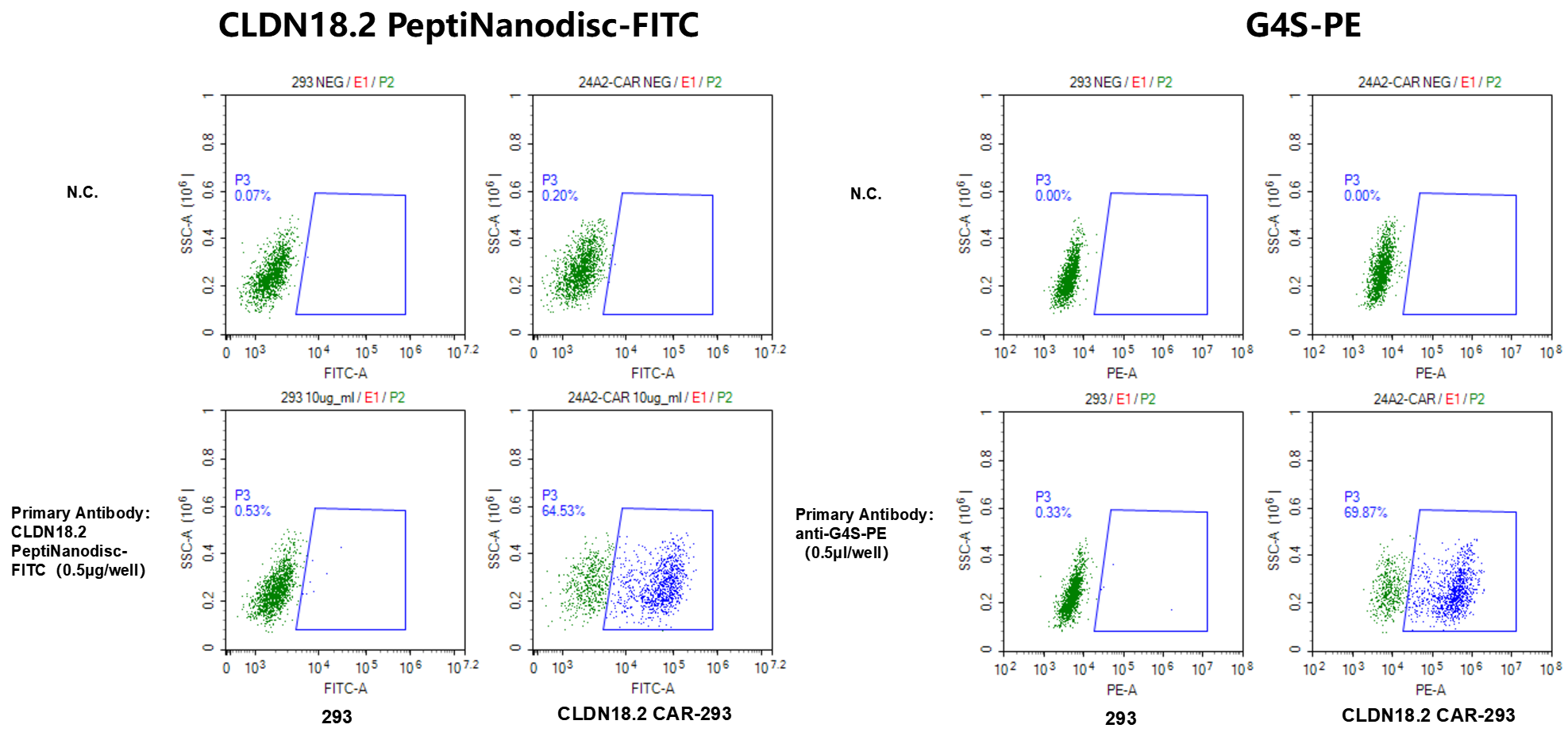
Compared with indirect detection methods that require the addition of a fluorescent secondary antibody, FITC-labeled PeptiNanodisc can be directly incubated with CAR cells for flow cytometry analysis, without the need for an additional fluorescent secondary antibody. This helps to:
Simplify the experimental workflow
Shorten detection time
Reduce nonspecific background introduced by secondary antibodies
Minimize experimental variation caused by different batches of secondary antibodies
More importantly, this method is based on the specific binding between the full-length target antigen and the CAR, enabling CAR expression detection and antigen-binding validation to be combined in a single experiment.
2.2 Providing a more functionally relevant detection tool for CLDN18.2 CAR development
Full-length CLDN18.2 PeptiNanodisc can be used for:
CLDN18.2 CAR positivity detection
Comparison of different scFv or CAR structure candidates
Orthogonal validation of CAR surface expression and target antigen binding
Research and method development for engineered cells such as CAR-T and CAR-NK cells
In practical research, PeptiNanodisc can also be used in combination with Protein L, anti-Fab, or anti-linker antibodies:
|
Detection Method |
Main Detection Dimension |
|
Protein L, anti-Fab, anti-linker |
Whether CAR-related structures are expressed |
|
CLDN18.2 PeptiNanodisc |
Whether the CAR can recognize full-length CLDN18.2 |
|
FITC-labeled PeptiNanodisc |
Direct detection of CAR positivity and the proportion of target-binding cells |
By cross-validating detection methods based on different principles, researchers can more comprehensively evaluate the expression status and antigen-binding capability of CAR constructs.
Not only detecting whether the CAR is expressed, but also verifying whether it can recognize the real target
As CLDN18.2 CAR-T officially enters the commercialization stage, solid tumor cell therapies are expected to further expand toward more complex membrane protein targets. For membrane protein targets that rely on native conformation and spatial epitopes, PeptiNanodisc uses soluble and stable full-length membrane proteins as detection antigens, providing a more direct solution for CAR positivity detection and target-binding validation.
Detect CAR positivity with the full-length target antigen, making every positive signal closer to true target recognition.
More CLDN18.2-related products
Contact DIMA Biotechnology today to obtain CLDN18.2 PeptiNanodisc sample information, complete detection data, or customized solutions.
